Emergency Medical Services Supplies: Complete Guide 2026
Emergency medical services professionals respond to life-threatening situations daily, making the quality and availability of their supplies critical to patient outcomes. Whether you're a paramedic, EMT, first responder, or someone building preparedness capabilities, understanding emergency medical services supplies ensures you're equipped to handle any crisis. From basic wound care to advanced airway management, the right equipment can make the difference between life and death. This comprehensive guide explores the essential supplies, organizational strategies, and industry standards that define modern emergency medical response.
Understanding the Foundation of EMS Equipment
Emergency medical services supplies encompass a broad spectrum of equipment designed for pre-hospital care. These materials range from simple bandages to sophisticated monitoring devices, each serving a specific purpose in the chain of survival.
The medical requirements for ambulance design and equipment establish baseline standards that ensure consistent care quality across different response scenarios. Professional responders rely on these standardized supply lists to maintain readiness.
Core Supply Categories
Airway and breathing equipment forms the first critical category. This includes:
- Bag-valve masks in multiple sizes
- Oropharyngeal and nasopharyngeal airways
- Oxygen delivery systems and regulators
- Suction devices and catheters
- Advanced airway tools for paramedic-level care
Hemorrhage control supplies represent the second essential category, addressing the leading cause of preventable death in trauma situations. Hemostatic agents like QuikClot and Celox have revolutionized bleeding control, allowing responders to manage severe hemorrhage more effectively than traditional pressure alone.
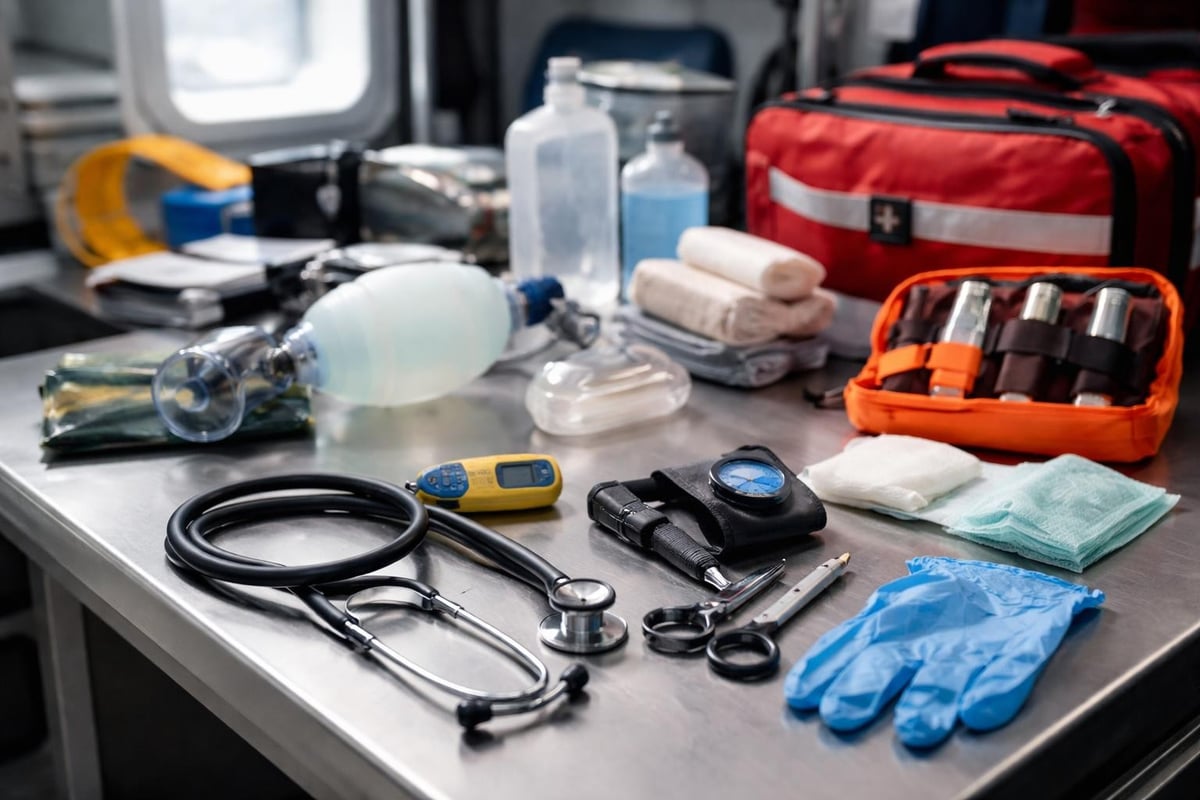
Patient assessment tools enable responders to gather vital information quickly. Blood pressure cuffs, stethoscopes, pulse oximeters, and thermometers provide objective data that guides treatment decisions. Glucometers have become standard equipment as metabolic emergencies increase in frequency.
Building Comprehensive Response Kits
Emergency medical services supplies must be organized strategically to enable rapid access during high-stress situations. The configuration varies based on the response environment and level of care provided.
Trauma-Focused Supply Systems
| Supply Type | Primary Use | Typical Quantity |
|---|---|---|
| Tourniquets | Limb hemorrhage | 2-4 per kit |
| Chest seals | Penetrating thoracic trauma | 2-3 vented seals |
| Hemostatic gauze | Junctional hemorrhage | 2-3 packages |
| Pressure bandages | Wound compression | 3-5 assorted sizes |
| Trauma shears | Clothing removal | 1-2 pairs |
Trauma kits designed for EMS use prioritize life-threatening conditions following established protocols like MARCH (Massive hemorrhage, Airway, Respirations, Circulation, Hypothermia). This systematic approach ensures supplies address the most critical needs first.
The Los Angeles County EMS Agency guidelines provide detailed specifications for equipment standards that many jurisdictions adopt. These requirements cover everything from bandage dimensions to medication storage protocols.
Medical Assessment and Intervention Supplies
Beyond trauma care, emergency medical services supplies must support medical emergencies like cardiac events, respiratory distress, and diabetic emergencies.
Cardiac care equipment includes automated external defibrillators (AEDs), aspirin for suspected myocardial infarction, and nitroglycerin for chest pain management. Advanced providers carry additional medications and 12-lead ECG capabilities.
Respiratory support supplies extend beyond basic oxygen delivery. Nebulizers for bronchodilator administration, continuous positive airway pressure (CPAP) devices, and emergency inhalers address various breathing emergencies.
Diabetic emergency supplies encompass glucometers, oral glucose preparations, and glucagon for severe hypoglycemia. These simple interventions prevent permanent neurological damage when blood sugar drops dangerously low.
Specialized Equipment for Different Response Scenarios
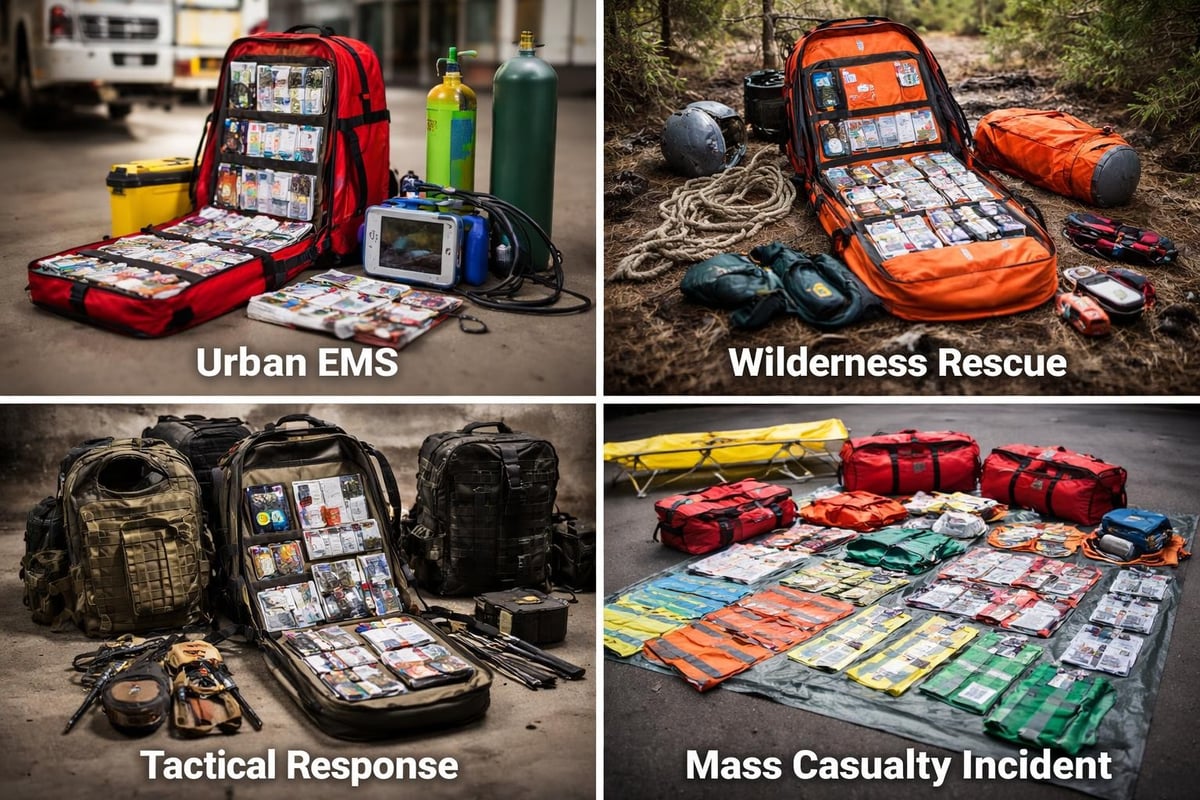
The diversity of emergency situations demands specialized emergency medical services supplies beyond standard configurations. Response environments significantly influence equipment selection.
Tactical and Remote Response Considerations
Tactical medical providers require compact, durable supplies that perform under extreme conditions. Equipment must withstand environmental challenges while remaining lightweight enough for extended operations.
- Compact airway kits with minimal bulk
- Combat-tested tourniquets and holders
- Self-adhering bandages that don't require tape
- Individual first aid kits (IFAKs) for self-care
- Rugged carrying systems for harsh environments
First responder kits designed for law enforcement and security personnel emphasize hemorrhage control and penetrating trauma management, reflecting the injury patterns these professionals encounter.
Remote wilderness response presents different challenges. Extended evacuation times require supplies that stabilize patients for hours rather than minutes. Splinting materials, wound irrigation systems, and expanded medication protocols become essential.
Mass Casualty and Disaster Response
Large-scale incidents demand scalable supply systems that serve multiple patients simultaneously. Bulk items enable responders to stock multiple treatment positions efficiently.
Triage supplies help organize chaotic scenes. Colored tags identify patient priority levels, allowing effective resource allocation. Simple ribbon systems provide visual markers visible from a distance.
Multiple casualty caches contain standardized supply sets for treating specific injury patterns. Pre-positioned equipment reduces response times when disasters strike. The indicators and triggers for EMS during crises guide deployment decisions for these reserve supplies.
Quality Standards and Regulatory Considerations
Emergency medical services supplies must meet rigorous performance standards to ensure reliability when lives depend on them. Understanding these requirements helps responders select appropriate equipment.
Certification and Compliance Requirements
The Food and Drug Administration (FDA) regulates medical devices based on risk classification. Class I devices like bandages face minimal oversight, while Class II devices like tourniquets require demonstration of substantial equivalence to approved devices.
Sterility considerations affect many emergency medical services supplies. Wound care products, intravenous equipment, and surgical instruments require sterile packaging that maintains integrity until use. Expired sterile supplies lose this certification, creating liability concerns.
Testing standards validate equipment performance. The Committee on Tactical Combat Casualty Care (CoTCCC) evaluates tourniquets through standardized protocols measuring effectiveness and durability. Only approved models should be used for life-threatening hemorrhage.
Storage and Maintenance Protocols
| Maintenance Task | Frequency | Purpose |
|---|---|---|
| Inventory check | Weekly | Identify missing items |
| Expiration review | Monthly | Remove expired supplies |
| Equipment testing | Monthly | Verify functionality |
| Complete audit | Quarterly | Comprehensive assessment |
| Replacement rotation | As needed | Maintain readiness |
Temperature-sensitive medications and supplies require controlled storage environments. Extreme heat or cold degrades many pharmaceutical products, reducing effectiveness or creating dangerous byproducts.
Emerging Technologies in Emergency Response Equipment
Innovation continuously improves emergency medical services supplies, introducing capabilities that enhance patient care and operational efficiency. Understanding these developments helps responders stay current.
Smart Technology Integration
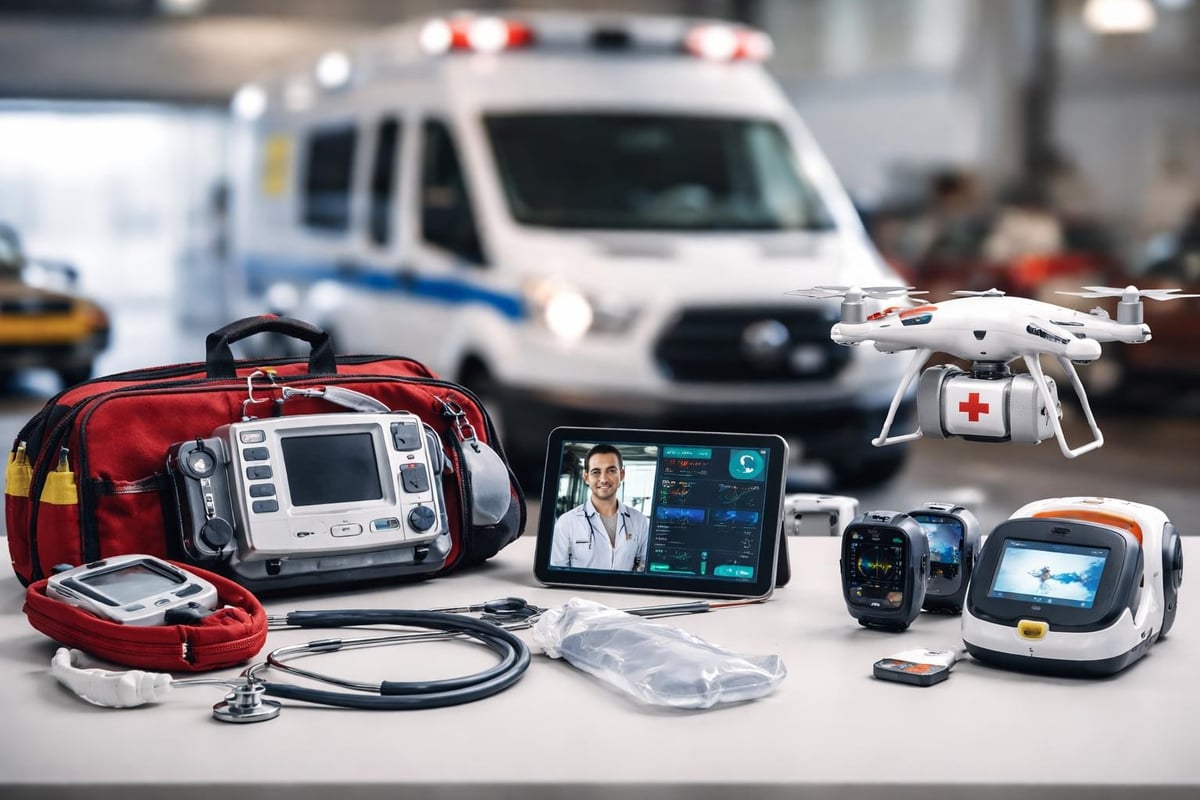
Point-of-care testing devices bring laboratory capabilities to the field. Portable blood analyzers measure lactate levels, electrolytes, and cardiac markers, providing data that previously required hospital laboratories. Research into cognitive assistance systems explores how artificial intelligence might guide supply selection and treatment protocols.
Wearable technology assists responders during operations. Smart-glasses systems designed for EMS personnel overlay vital information onto the responder's field of view, enabling hands-free access to protocols and patient data while maintaining situational awareness.
Telemedicine capabilities expand consultation options during complex cases. Portable cameras and communication systems connect field providers with hospital-based specialists who guide treatment decisions remotely.
Innovative Delivery Systems
Drone-enhanced emergency medical services represent a paradigm shift in supply delivery. Unmanned aircraft systems transport AEDs, medications, and blood products to remote locations faster than ground vehicles, particularly in congested urban environments or wilderness areas.
Compact resuscitation devices reduce the physical demands of CPR. Mechanical chest compression systems maintain consistent compressions during extended resuscitations or patient movement, freeing responders for other critical tasks.
Advanced wound care products incorporate nanotechnology and biomaterials. Next-generation hemostatics activate faster and control bleeding more effectively than earlier formulations, improving survival rates from severe trauma.
Professional Development and Supply Competency
Possessing emergency medical services supplies means little without the knowledge to use them effectively. Comprehensive training ensures equipment investment translates into improved patient outcomes.
Skill-Based Equipment Selection
Scope of practice limitations determine which supplies individual responders can legally use. Basic life support providers focus on non-invasive interventions like chest seals and bandaging, while advanced providers utilize medications and invasive procedures.
Training requirements vary by equipment complexity:
- Basic supplies like bandages require minimal instruction
- Intermediate equipment such as tourniquets needs hands-on practice
- Advanced devices like supraglottic airways demand formal certification
- Specialized tools require ongoing competency verification
Regular skills maintenance prevents degradation over time. Studies show psychomotor skills decline rapidly without practice, making periodic refresher training essential for maintaining competency with critical emergency medical services supplies.
Building Organizational Supply Programs
Healthcare facilities and response agencies benefit from standardized supply programs. The Texas Department of State Health Services resources provide frameworks for developing comprehensive equipment management systems.
Supply chain management ensures continuous availability. Multiple vendor relationships prevent single-source dependencies that leave organizations vulnerable to supply disruptions. The COVID-19 pandemic highlighted this vulnerability when global shortages affected even basic personal protective equipment.
Budget optimization balances quality with cost considerations. While premium emergency medical services supplies often justify their expense through superior performance, some commodity items provide adequate function at lower prices. Understanding these distinctions maximizes purchasing power.
Customizing Supplies for Specific User Groups
Different responder categories require tailored emergency medical services supplies that match their operational environments and training levels. One-size-fits-all approaches compromise effectiveness.
Public Access and Civilian Preparedness
Layperson responders benefit from simplified equipment that requires minimal training. Complete kits designed for civilian use include clear instructions and eliminate supplies requiring medical knowledge to apply safely.
Home preparedness kits address common household emergencies. Burns, lacerations, and minor trauma represent typical scenarios where home care kits provide appropriate intervention capabilities without overwhelming users with complex equipment.
Workplace response kits comply with Occupational Safety and Health Administration (OSHA) requirements while addressing industry-specific hazards. Manufacturing environments need extensive burn treatment supplies, while office settings prioritize basic wound care and cardiac emergency equipment.
Professional and Semi-Professional Applications
Industrial response teams, security personnel, and athletic trainers occupy the space between layperson and certified EMS provider. These groups require more sophisticated emergency medical services supplies than civilians but operate under different protocols than traditional EMS.
Industrial first aid programs often include extensive response kits containing supplies for multiple simultaneous patients. Manufacturing accidents may involve several injured workers, requiring scalable treatment capabilities.
Athletic training supplies emphasize musculoskeletal injuries, environmental emergencies, and cardiac events common in sports settings. Automated external defibrillators, ice therapy equipment, and immobilization devices form the core of these specialized kits.
Supply Chain Resilience and Contingency Planning
Recent global events have demonstrated how quickly supply chains collapse under stress. Building resilient emergency medical services supplies procurement strategies protects response capabilities during crises.
Strategic Reserve Development
Organizations should maintain supplies beyond immediate operational needs. Strategic reserves provide buffer capacity when normal procurement channels fail or demand suddenly increases.
Rotation systems prevent waste from expiration. First-in, first-out inventory management uses older stock first while continuously replenishing reserves with fresh supplies. This approach maintains readiness without accumulating unusable expired materials.
Supplier diversification reduces dependency on single sources. The CDC's research methodology for EMS includes considerations for equipment availability and supply chain stability in healthcare planning.
Alternative Sourcing Strategies
Direct manufacturer relationships eliminate intermediary markups and provide priority access during shortages. Many companies offer dedicated account management for high-volume purchasers, ensuring allocation when supplies become scarce.
Group purchasing organizations leverage collective buying power to negotiate better pricing and terms. Multiple agencies combine their procurement volume, gaining advantages individual organizations cannot achieve alone.
Cross-training on equipment variations prevents operational paralysis when preferred products become unavailable. Responders familiar with multiple tourniquet models, for instance, can adapt when their usual choice is out of stock.
Educational Resources and Continuing Education
Maximizing the value of emergency medical services supplies requires ongoing education about proper use, emerging best practices, and new product developments. The American Academy of Orthopaedic Surgeons' EMS resources provide evidence-based guidance on equipment utilization.
Formal Training Opportunities
Certification courses teach systematic approaches to equipment use. Stop the Bleed programs, for example, focus specifically on hemorrhage control supplies, teaching tourniquet application, wound packing, and pressure techniques.
Manufacturer training often accompanies sophisticated equipment purchases. Companies providing advanced airway devices or monitoring equipment typically offer implementation support ensuring users understand proper operation and troubleshooting.
Continuing medical education keeps providers current with evolving standards. ASPR TRACIE technical resources offer various educational materials addressing emergency medical services equipment and best practices.
Practical Skills Development
Simulation training with actual emergency medical services supplies builds confidence and competence. Realistic manikins and task trainers allow repeated practice without risk to actual patients.
Scenario-based exercises integrate equipment use with decision-making skills. Responding to simulated emergencies requires selecting appropriate supplies, prioritizing interventions, and adapting to complications, closely mirroring real-world conditions.
Peer review and quality improvement programs identify equipment use patterns that might indicate training gaps or procedural drift. Regular case reviews ensure supplies are used according to established protocols and manufacturer guidelines.
Understanding emergency medical services supplies empowers both professionals and prepared civilians to respond effectively when emergencies strike. The right equipment, properly maintained and skillfully deployed, directly improves survival rates and reduces complications from traumatic injuries and medical crises. Whether you're building institutional response capabilities or personal preparedness, Medical Gear Outfitters provides paramedic-selected equipment and the expertise to use it effectively, ensuring you're ready to act as a first responder when lives depend on it.